
Using radiotherapy to help immune cells penetrate and kill solid tumors

Radiotherapy is a cornerstone of treatment for solid tumors. Immunotherapy has transformed the care of blood cancers but has so far been much less effective against solid tumors. We study how radiotherapy reshapes the surface of cancer cells and the stress signals inside tumors, with two ultimate goals: finding new targets for immunotherapy, especially engineered CAR-T cells, and releasing the brakes that tumors place on CAR-T cells and mRNA vaccines.
Gemini Generated Image Lsunvjlsunvjlsun E1794809786193

Two questions drive the lab

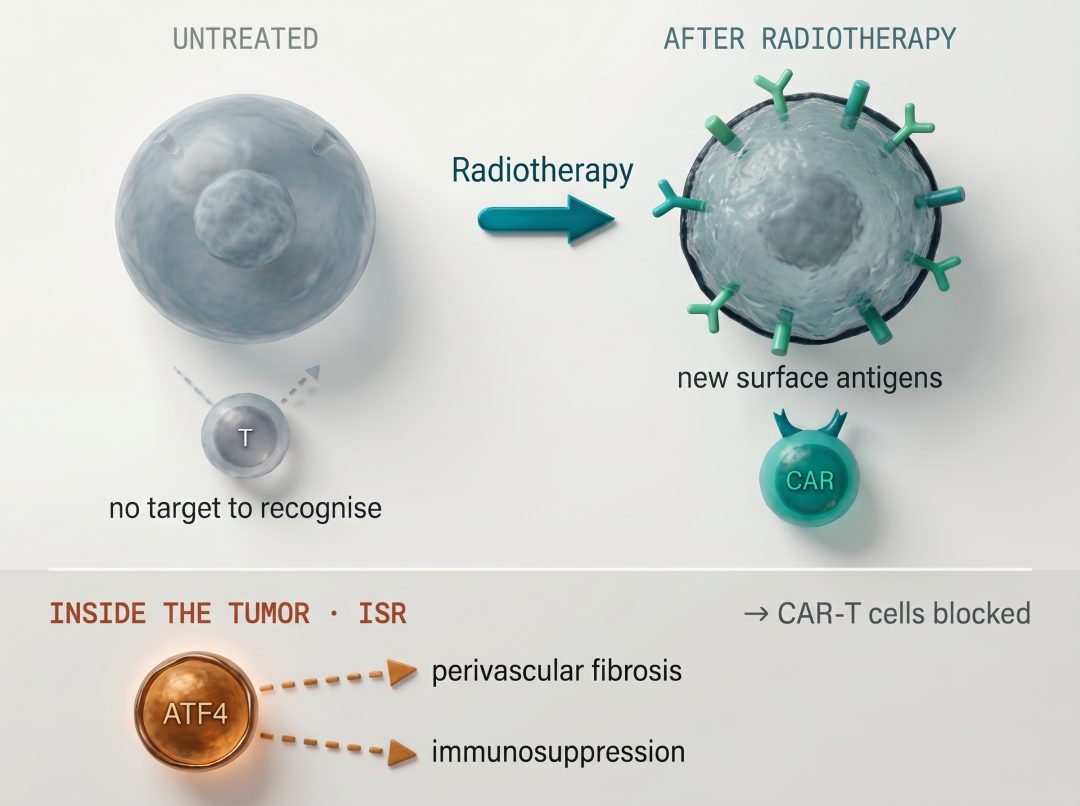
CAR-T cells have transformed the treatment of blood cancers, but they are much less effective in solid tumors, due to lack of a reliable or sustained target, poor penetration into the tumor, and being suppressed (“switched off”) once inside. We work on these problems in pancreatic cancer (PDAC) and glioblastoma (GBM), where five-year survival is below 10%.

What new targets appear on the tumor surface after radiation?

Radiation does more than kill cancer cells. It can release “danger signals” from the dying tumor cells  attracting immune cells and can change which proteins the surviving cells display on their surface (e.g., see Amit et al., PNAS 2025). Some of these could become new targets for CAR-T cells.  Our general approach entails:

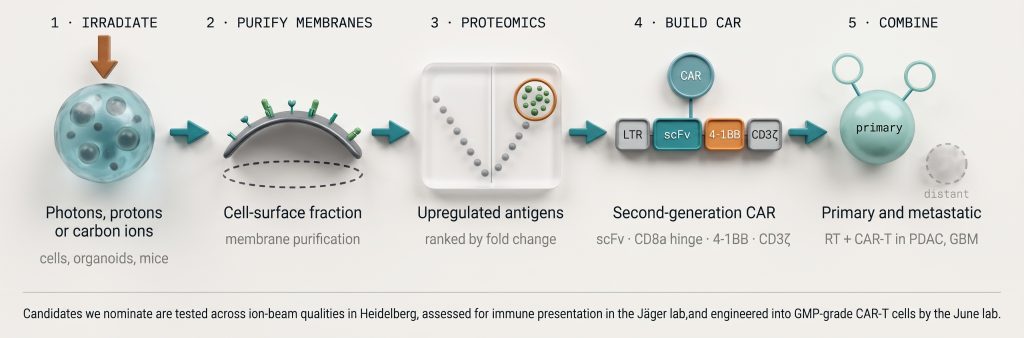
  • Irradiating mouse tumors and patient-derived human tumor organoids across doses and radiation types
  • Mapping the cell-surface proteome with quantitative proteomics, and tracking expression with RNA-seq and scRNA-seq
  • Ranking candidates by how much they rise, how tumor-specific they are, and how long they persist
  • Building CAR-T cells against the best candidates with the June lab, and test them together with radiation
Gemini Generated Image Es1rdves1rdves1r 1024x338
Placeholder

How do tumor stress signals suppress the immune system? Can we identify critical nodes and target them pharmacologically?

The integrated stress response (ISR) helps cells survive low oxygen, nutrient shortage and radiation damage. Its central regulator, the transcription factor ATF4, also shapes the cells around the tumor in ways that keep immune cells out and switched off. (e.g., see Verginadis et al., Nat. Cell Bio, 2022)

  • Using conditional or tissue-specific mouse knockout models and CRISPR-technology to identify the ISR nodes (PERK, eIF2α, ATF4) that contribute most to a suppressive microenvironment-emphasis is on stromal components such as Cancer Associated Fibroblasts and immune components relying on tonal ISR activation
  • Blocking signaling from these nodes pharmacologically to reduce perivascular fibrosis and
  • Combining ISR blockade with radiotherapy (photon or particle RT) so CAR-T cells can reach the bulk of the tumor and remain functional once there
  • Test whether the same approach strengthens mRNA cancer vaccine responses
isr blockade

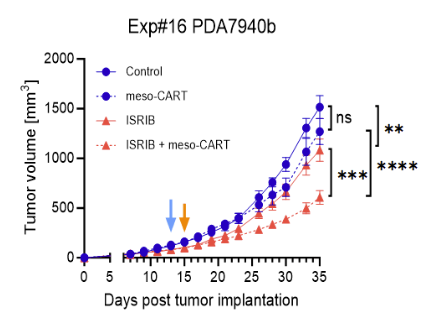
ISR blockade and CAR-T work better together.

PDA7940b tumor volume over 35 days. CAR-T alone does not differ from control in this model, while ISRIB slows growth and the combination is the most effective (blue and orange arrows mark CAR-T infusions).
Why this matters for patients

Radiotherapy is one of the most common cancer treatments. CAR-T therapy is a newer treatment in which a patient’s own immune cells are engineered to recognize and kill cancer cells. CAR-T works well in some blood cancers but not yet in solid tumors such as pancreatic cancer or brain tumors.

We think radiation can help. It can make cancer cells easier for immune cells to spot, and if we also block the stress signals tumors use to protect themselves, immune treatments may work much better. Our aim is to design combined treatments that can move into clinical trials.

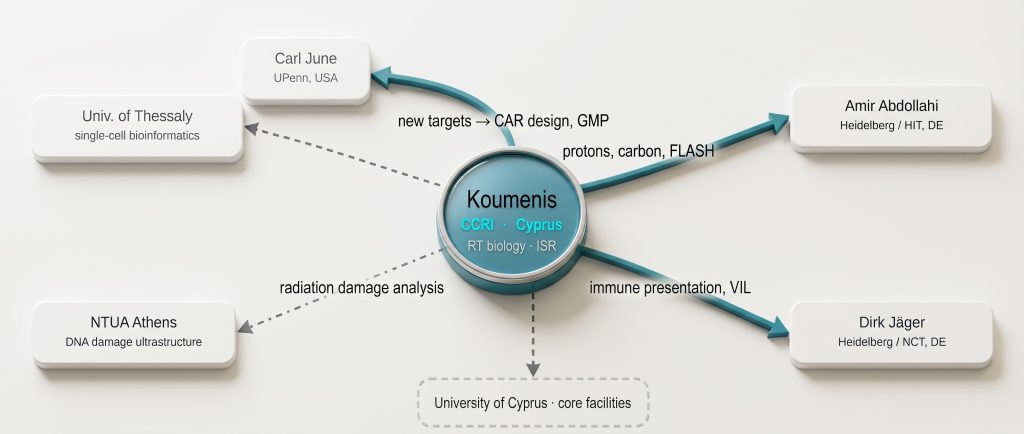
One part of a four-lab effort against tumor immune evasion

The PRECISION-ImmunoRad team brings together precision particle radiotherapy, stress-response biology, personalized cancer vaccines and CAR-T engineering, with the goal of reprogramming the tumor immune microenvironment. The collaborating PIs and Institutions are:

gemini generated image pu93q8pu93q8pu93

Models & tools

From the bench in Nicosia to the ion beams in Heidelberg

Models & tools

Image-guided irradiation

We are installing a Small Animal Radiation Research Platform at CCRI, the first animal irradiator in Cyprus, for photon proof-of-concept studies with CAR-T cells. Key results are then confirmed with helium and carbon ions at the Heidelberg Ion-Beam Therapy Center.

Orthotopic and flank PDAC and GBM models in C57BL/6 mice, genetically engineered Pdx1-Cre; LSL-KrasG12D; p53fl/fl (KPC) mice, ATF4-deficient hosts, and patient-derived tumor organoids.

Membrane proteomics, bulk and single-cell RNA-seq, multicolor flow cytometry, qPCR and live-cell fluorescence imaging.

The PI helped pioneer ultra-high dose-rate (FLASH) proton radiotherapy at UPenn, which spares normal tissue while maintaining tumor control. We are testing whether its immune effects depend on linear energy transfer (LET, keV/µm) at HIT in Heidelberg.

University of Thessaly (Dr. Hatzigeorgiou, single-cell bioinformatics), National Technical University of Athens (Dr. Georgakilas, radiation-induced DNA damage), and Core facilities at the University of Cyprus and Karaiskakio Foundaiton

Groundwork for this program

Scroll to Top